






Are you running your online business with a clear system, or are you just working from a long, messy task list?
An online marketing system changes everything. Instead of doing something like, “What are my options for posting today?” you know the next move. Instead of jumping between tools, you follow a plan.
Most people don’t fail because they lack effort. They fail because they lack structure. They’re busy. They’re posting. They’re tweaking websites. But it’s scattered. And scattered work rarely builds steady income.
Let’s fix that.
A lot of beginners and even intermediate marketers treat their business like a to-do list.
Nothing connects. There’s no flow.
This usually happens for three reasons:
1. Too much advice. Every guru says something different.
2. Shiny object habit. New tool. New strategy. New platform.
3. No defined path. You don’t know how a stranger becomes a buyer.
Without an online marketing system, you’re reacting. With a system, you’re guiding people through a journey. That’s the difference.
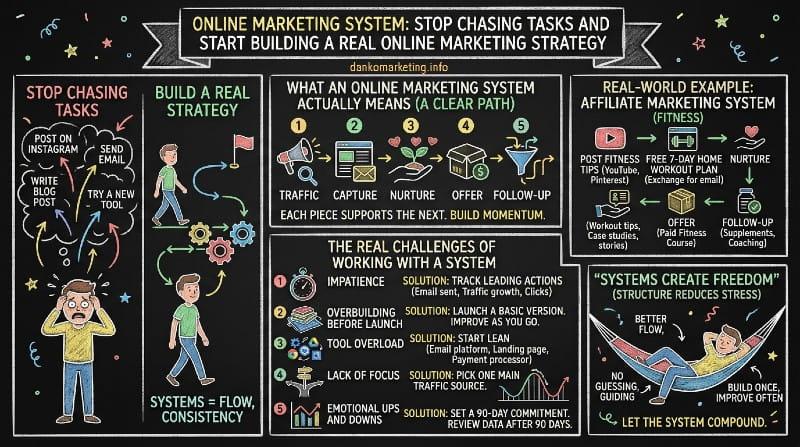
An online marketing system is not complex. It’s just a clear path from attention to sale.
Here’s a simple version:
1. Traffic – How people find you.
2. Capture – How you collect emails.
3. Nurture – How you build trust.
4. Offer – What you sell.
5. Follow-up – How you increase lifetime value.
That’s it.
When you treat your business like a system, each piece supports the next. Your content drives traffic. Your traffic feeds your email list. Your email list drives sales. Your sales fund growth.
Now you’re building momentum instead of spinning your wheels.
Let’s be honest. Building a system sounds simple. Sticking to it is harder.
Here are the real problems online marketers face – and what to do about them.
A system takes time to show results.
You might write content for weeks before traffic grows. You may send emails before sales feel steady. Many quit too soon.
Solution:
Track leading actions, not just money.
If those rise, sales will follow. Focus on input before outcome.
Some people spend months building funnels, branding, logos, and automations. Nothing goes live.
Perfection becomes a trap.
Solution:
Launch a basic version first.
Improve as you go. Systems grow stronger through real data, not endless planning.
New marketers often think software equals progress. They stack tools like trophies.
More tools. More confusion.
Solution:
Start lean. You only need:
Master those. Add tools only when the system demands it.
4. Lack of Focus
A system requires saying no.
No to every platform. No to every trend. No to random product ideas. That feels risky.
Solution:
Pick one main traffic source.
You can expand later. But focus builds depth. Depth builds trust. Trust builds income.
When you run scattered tasks, small wins feel huge and small losses feel crushing.
A system smooths this out, but only if you trust it.
Solution:
Set a 90-day commitment. No pivoting. No major changes. Run the system consistently. Review data after 90 days.
Consistency beats emotion every time.
Let’s look at a simple affiliate marketing setup.
Imagine someone promoting fitness programs.
Instead of randomly posting affiliate links, they build this system:
Step 1: Traffic
They post short fitness tips on YouTube and Pinterest.
Step 2: Capture
Each video links to a free “7-Day Home Workout Plan” in exchange for an email.
Step 3: Nurture
New subscribers receive:
Trust builds.
Step 4: Offer
After value is delivered, they recommend a paid fitness course as an affiliate.
Step 5: Follow-up
They later promote supplements and coaching programs to the same list.
That’s an affiliate marketing system.
Notice something. The content is not random. The emails are not random. The offer matches the audience.
The system does the heavy lifting.
You don’t need to overhaul your whole business. Start small.
Ask yourself:
Then map it out.
Write it on paper if you have to. Clarity changes everything.
When each piece connects, marketing feels calmer. You’re not guessing. You’re guiding.
Here’s the part many miss.
A scattered task list keeps you busy. A system creates space.
When your email funnel runs daily, you’re not stuck chasing new sales every morning. When your content follows a clear theme, you’re not staring at a blank screen.
Structure reduces stress.
That’s true whether you’re 25 and building your first side hustle or 60 and growing a second income stream. The rules stay the same.
Build once. Improve often. Let the system compound.
You don’t need more hustle. You need better flow.
If you want practical breakdowns like this, plus step-by-step ideas for affiliate marketing, email funnels, digital products, and more, join my free newsletter. Each week I share clear strategies and tips you can actually use.
Quick Links
Important Links
Get In Touch
One of the best opportunities provided through online affiliate marketing is the ability to use a variety of strategies and techniques to develop and create a sustainable online business.
Disclaimer: There may be a material connection on this site including pages/posts that may contain affiliate links of which I may receive a commission for anything purchased.
© 2026 Online Affiliate Marketing | Build an Online Presence | Web Development By TEKware